[via 9Gag]
Is Facebook about to start charging its users to access the social network? No, but a new chain letter making its way across Facebook walls wants you to think so.
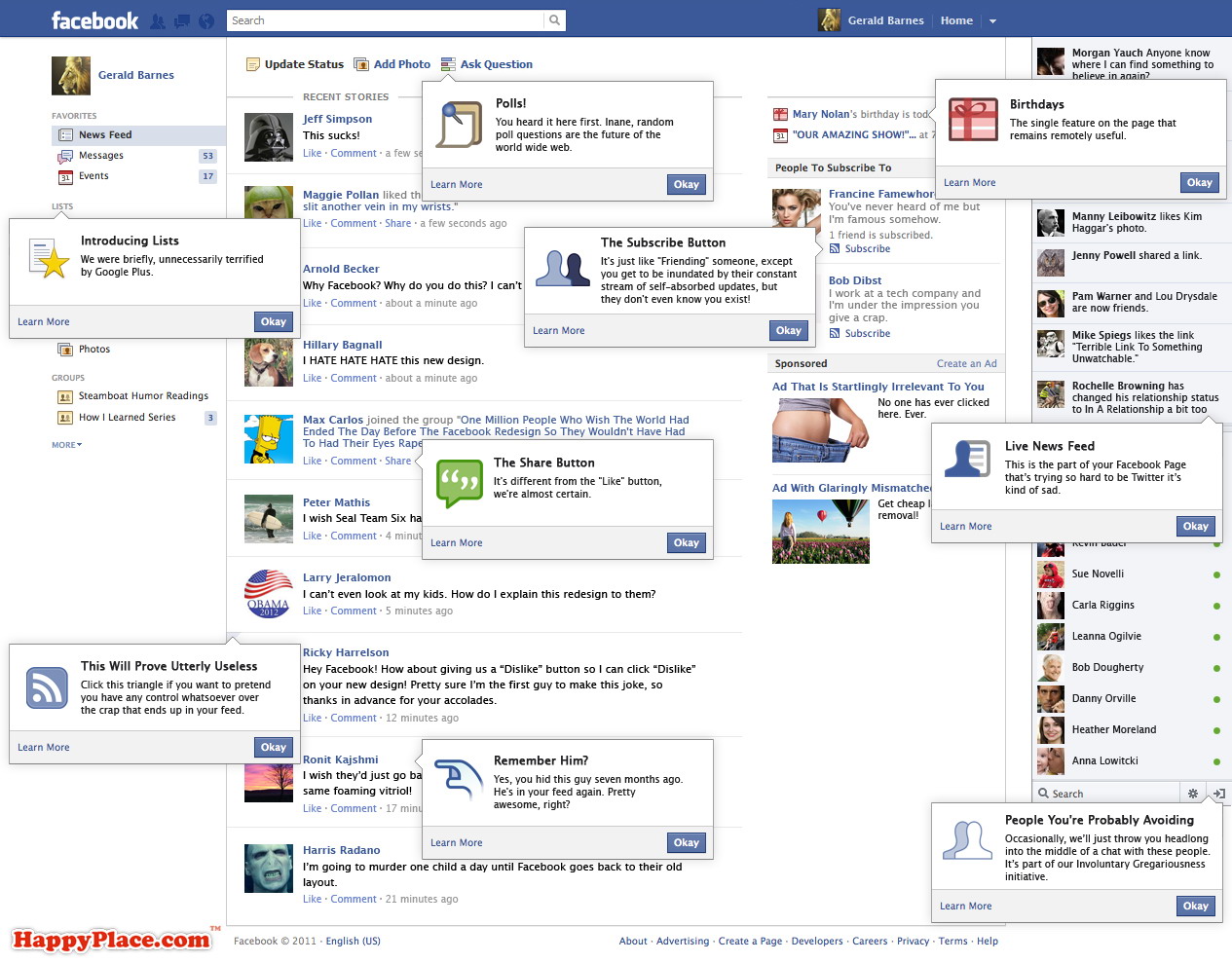
This rumor comes after Facebook's recent f8 conference in San Francisco, where the company announced sweeping changes to its Open Graph platform, allowing more sharing than ever before. During the event, Facebook also unveiled a radical new profile layout that will significantly change the look of users' personal pages.
The chain letter claiming Facebook will begin charging this year alleges that the site must charge its users a fee to pay for the new profile design.
The phony warning reads thus:
IT IS OFFICIAL. IT WAS EVEN ON THE NEWS. FACEBOOK WILL START CHARGING DUE TO THE NEW PROFILE CHANGES. IF YOU COPY THIS ON YOUR WALL YOUR ICON WILL TURN BLUE AND FACEBOOK WILL BE FREE FOR YOU. PLEASE PASS THIS MESSAGE ON, IF NOT YOUR ACCOUNT WILL BE DELETED IF YOU DO NOT PAY
Be the first kid on the block to get the New Facebook Profile
Surprise surprise, I just finished up sharing a new blog post and bam, I get hit with virtual confetti and a message on the Tumblr dashboard that Tumblr has reached its 10 billionth post. I wish I was that person that submitted the historic post, but don’t think I am that lucky.It’s nice to see though that Tumblr is growing at such a fast (and competitive) rate. I really believe that Tumblr is becoming the go-to place to blog for hobbyists and professionals. There was some rocky times last year, but so far in 2011 the platform has been stable and showing great improvements.

If you've got a commenter account on any Gawker Media site, change your password. Gawker Media's entire commenter database was hacked on Saturday by a group called Gnosis, and over 250,000 passwords were posted on The Pirate Bay.


Why do Microsoft, Google, Apple, and others think that it is an OK practice to add plug-ins to Firefox when I'm installing their software packages. When I installed iTunes, in order to manage my music collection and sync to my iPod, why did Apple think it was OK to add the iTunes Application Detector plug-in to my Firefox web browser without asking me? Why did Microsoft think it was OK to sneak their Windows Live Photo Gallery or Office Live Plug-in for Firefox into my browser (presumably) when I installed Microsoft Office? What makes Google think it's reasonable behavior for them to slip a Google Update plug-in into Firefox when I installed Google Earth or Google Chrome (not sure which one caused this) without asking me first?Read the full post here.
This is not OK behavior....In my book, that fits the definition of a trojan horse. Yes, that is precisely how a trojan horse operates. These additional pieces of software installed without my consent may not be malicious but the means by which they were installed was sneaky, underhanded, and wrong.
I repeat: this is not OK.
......Microsoft, stop being evil. Apple, stop being evil. Google, stop being evil. And you upstarts like RockMelt, don't follow in those evil footsteps. It's not worth it.
It's really simple. ASK first!
Using Facebook is the online equivalent of staring at yourself in the mirror, according to a study.
Those who spent more time updating their profile on the social networking site were more likely to be narcissists, said researchers.
Facebook provides an ideal setting for narcissists to monitor their appearance and how many ‘friends’ they have, the study said, as it allows them to thrive on ‘shallow’ relationships while avoiding genuine warmth and empathy.
They also tend to use the site for promoting themselves to friends or people they would like to meet, the study concluded.
Researcher Soraya Mehdizadeh from York University in Canada asked 100 students, 50 male and 50 female, aged between 18 and 25 about their Facebook habits.
They all took psychology tests to measure their levels of narcissism, which the study defined as ‘a pervasive pattern of grandiosity, need for admiration, and an exaggerated sense of self-importance’. Those who scored higher on the narcissism test checked their Facebook pages more often each day than those who did not. There was also a difference between men and women – men generally promoted themselves by written posts on their Facebook page while women tended to carefully select the pictures in their profile.
The findings, published in the journal Cyberpsychology, Behaviour And Social Networking, also suggested that those with low self-esteem also checked their Facebook pages more regularly than normal.
As some people noticed, at approximately 10:30 pm PST on Monday evening the main site in the TechCrunch Network – techcrunch.com – was hacked and redirected. The site was back up briefly at 11:30 pm but shortly went down again. As of 2:00 am, the site is back up and appears to be stable.
At this point we’re still gathering information on how the site was compromised, and will update this post with additional information.
Sadly BlackBerry outages are becoming a common occurrence these days. This afternoon our tip box was overloaded with users who wanted to know why their BlackBerry Messenger wasn’t working. Then we received more tips that BlackBerry e-mail was down and this outage was also affecting web browsing so we knew something was wrong.[via Mashable]

Google has acquired ReCaptcha, one of those companies behind the distorted text boxes at the bottom of many Web site sign-in pages.[via Frenzy Blogging]
Terms of the deal were not disclosed, but Google plans to use ReCaptcha's technology both as a security measure within certain Google sites and to make its massive book-scanning project a little smarter, the company said in a blog post. ReCaptcha is an offshoot of Carnegie Mellon University's School of Computer Science, and puts a twist on the traditional captcha: a string of letters in squiggly text meant to confuse spam bots and other nonhuman Web pests.
The idea behind a captcha is to confuse a computer, but computers are also confused by some words written in fonts used long ago. ReCaptcha offers two words, one of which is a captcha it already knows, and one of which is a word it doesn't know. The thinking is that if you get the first word right, you're likely a human and you're also probably going to get the second one right.


Mininova has lost its civil dispute with Dutch anti-piracy outfit BREIN. The judge ruled that Mininova is not directly responsible for any copyright infringement, but ordered it to remove all torrents linking to copyrighted material within three months, or face a penalty of up to 5 million euros.
Mininova were sued this spring by BREIN, an outfit which protects the rights of several large entertainment industry corporations.
Today, the judge ruled that the world’s largest BitTorrent indexer has been ordered to clean up its site and remove all torrents that link to infringing content.
BREIN’s intention was not to shut down the site. Instead, the organization called for a filter based on infringing keywords and possibly digital fingerprints to guarantee that the rights holders have sufficient means to protect their content.
The court agreed with BREIN’s assessment that Mininova is not doing enough to protect the rights of copyright holders, and ordered the site to remove all torrent files that link to infringing content within three months, or pay a penalty of 1000 Euro per infringing torrent with a maximum of 5 million euros ($7 million).

It looks like Facebook has tonight turned on a feature called “Facebook Lite” for some users to test out. We’re getting bombarded by tips about it, and some of us are seeing it as well. Unfortunately, it appears that it may not be fully ready for prime time yet, but we have more information and what looks to be a screenshot below, so keep reading.TechCrunch has posted an official response from Facebook
We are currently testing a simplified alternative to Facebook.com that loads a specific set of features quickly and efficiently. Similar to the Facebook experience you get on your mobile phones, Facebook “Lite” is a fast-loading, simplified version of Facebook that enables people to make comments, accept Friend requests, write on people’s Walls, and look at photos and Status updates. We are currently testing Facebook Lite in countries where we are seeing lots of new users coming to Facebook for the first time and are looking to start off with a more simple experience.
This evening, the test was temporarily exposed to a larger set of users by mistake. We have not opened up access to lite.facebook.com to all users at this time. People who are not part of the test and are trying to access “Lite” will be directed to Facebook.com as usual.